
Opening, Leaf or Post Spacing? Read a Chain-Link Gate Record
A chain-link gate field record should be read as a relationship between a specified requirement, a measured result and the method used to obtain it. QY's redacted example separates those elements for one project gate. It helps a buyer distinguish opening dimensions from gate-leaf dimensions and recorded acceptance from a general product specification.
Download the redacted QY field record, revision A/0 (Chinese PDF). This article explains selected entries; it is not a certified translation of the complete record. Project and personal identifiers are removed. The source was rechecked on 26 September 2026; that is not the concealed field-measurement date.
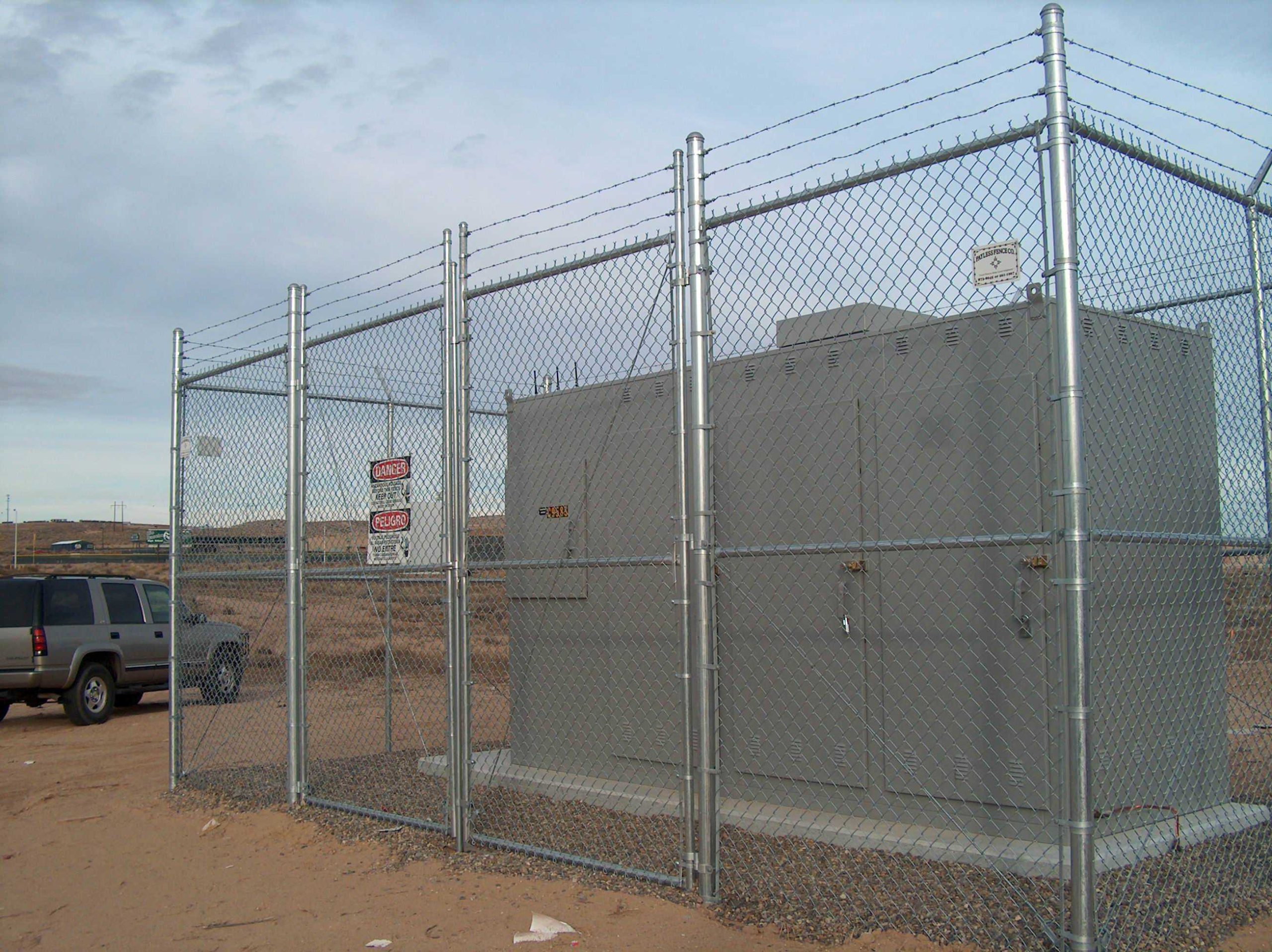
The featured QY chain-link enclosure photo is a separate visual example, not the gate represented by the PDF. It shows general gate-and-post context only and does not support any measurement in the table.
Six dimensions with different reference points
The following values are transcribed from page 1 of this single-project record. All dimensions in this table are in millimetres (mm); they are not catalogue dimensions or recommended tolerances for another gate.
| Recorded item | Design value or range in this record | Field value in this record | What is being described |
|---|---|---|---|
| Clear opening width | 1800 | 1797 | Opening between the inside faces of the retained posts |
| Clear opening height | 2000 | 2002 | From ground level to the underside of the opening's upper crossmember |
| Gate-leaf width | 1780 | 1779 | Width of the gate leaf, not the post-to-post opening |
| Gate-leaf height | 1980 | 1981 | Finished height of the chain-link gate leaf |
| Ground clearance | 20–50 | 35 | Gap between the gate bottom and ground |
| Retained-post centre spacing | 1860 | 1858 | Distance between post centres, not between inside faces |
These are different reference points. Quoting 1858 mm as the clear opening, for example, would mislabel the centre-spacing entry. Likewise, a leaf width or height is not a substitute for the corresponding opening measurement. The record also lists retained-post plumbness and straightness checks separately; those alignment entries are not gate-size dimensions. The table alone does not establish the required hinge or latch allowance for a replacement gate.
Read the method beside the number
Page 2 describes how this project's readings were recorded. Opening width was measured at the top, middle and bottom using a steel tape, then averaged. Opening height was measured from the ground to the underside of the upper crossmember at the left and right, then averaged. Ground clearance was measured with the gate fully closed, from the lowest point of its bottom edge to the hard ground surface.
This matters when comparing records: the reported width is an average, not a published set of three individual readings. The PDF does not provide those individual readings, so they cannot be reconstructed from the reported result. These are the methods stated in this record, not a universal measuring or installation procedure.
Keep hardware checks and acceptance in their project context
The hardware section records hinge quantity and position, latch position, locking clearance, opening angle and closing gaps. The method section also records visual checks and repeated manual opening and closing. A dimension, a visual observation and an operating check are different kinds of information; retaining those labels makes the record easier to interpret.
The document marks the project gate as accepted. That reports the source's conclusion; it does not independently establish the acceptance criteria for another project. In particular, do not infer a general allowable deviation merely because a design value and measured value differ and the row is marked accepted. This record is not a load rating, security certification, code approval, compatibility guarantee or proof of delivery.
Use the example without copying its specifications
Before discussing your own gate, identify which entries describe the opening, leaf, post centres and hardware; keep each requirement, measurement and method together. Use your own project drawing, revision and measurements, and retain a separate project-specific review decision. Do not copy this example's values or acceptance mark into a new inspection sheet.
For information needed before replacement matching, see the replacement chain-link gate interface guide. For product scope, see QY chain-link fencing. Contact QY with your drawing and the particular record entry you need clarified; this example does not approve a replacement design.
Basis and limits
- Basis: Approved redacted QY record revision A/0; SHA-256 c9df958fc715088a6754942e6d79986c2dea4ba4d508c7f5d602863643c6987b; source review covers source values/methods, not article prose.; Scope: Six labeled design/required and measured values, reference points/methods, and the record’s single-project conclusion.; Review: Revision A/0; source technical review recorded 2026-09-24; field-measurement date is undisclosed.; Limit: One redacted project record only; it proves no universal tolerance, design suitability, safety, code compliance, performance, compatibility or outcome.
Related links
Related products and RFQ guides
- Fencing and guardrails productsOpen the related product family section.
- Fencing and guardrails topic entryFencing and guardrail product pages for highway guardrails, welded mesh fence, chain link fence, double wire fence, municipal guardrails and railings.
- Welded mesh fenceRelated product or guide page.
- Chain link fenceRelated product or guide page.
- Welded Mesh Fence RFQ Guide for Site Boundary ProjectsRFQ guide for welded mesh fence projects covering boundary use, panel size, wire diameter, mesh opening, posts, finish, gates, accessories, quantity and destination.
- Chain Link Fence vs Welded Mesh Fence for Site Boundary RFQsFence comparison and RFQ guide covering chain link fence, welded mesh fence, panel or roll form, posts, coating, gates, accessories, quantity and destination.


