
Molded FRP Grating Weight: Panel, Cut Piece and Shipping Inputs
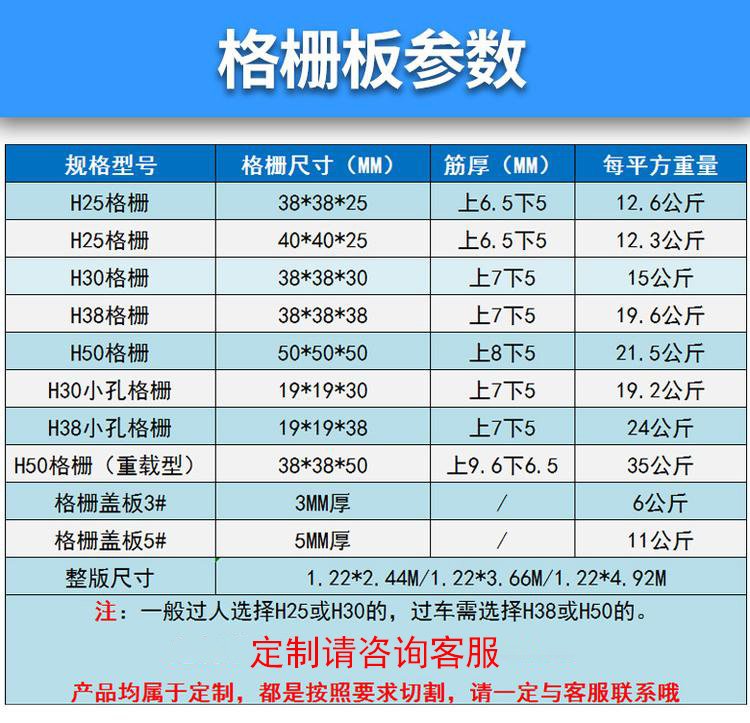
A molded FRP grating weight chart gives kg/m² for a specific construction, not one weight for every fiberglass panel. In QY's published parameter chart, the eight open-grating rows below range from 12.3 to 35 kg/m². Match the row before calculating: panel net weight = finished area × the matching kg/m² value. Packing is added separately to obtain shipment gross weight.
Molded FRP grating weight chart (kg/m²)
These are reference values transcribed from the QY parameter chart shown above. They describe that chart, not a current stock list or a load rating. Confirm the ordered construction, surface and unit weight on the quotation. The source labels the three dimensions below as “grating dimensions”; they are reproduced without reinterpreting the first two as clear openings or center spacing.
| Chart row | Listed dimensions (mm) | Listed rib thickness, top/bottom (mm) | Weight (kg/m²) |
|---|---|---|---|
| H25 | 38 × 38 × 25 | 6.5 / 5 | 12.6 |
| H25 | 40 × 40 × 25 | 6.5 / 5 | 12.3 |
| H30 | 38 × 38 × 30 | 7 / 5 | 15 |
| H38 | 38 × 38 × 38 | 7 / 5 | 19.6 |
| H50 | 50 × 50 × 50 | 8 / 5 | 21.5 |
| H30, small mesh | 19 × 19 × 30 | 7 / 5 | 19.2 |
| H38, small mesh | 19 × 19 × 38 | 7 / 5 | 24 |
| H50, 38 × 38 row | 38 × 38 × 50 | 9.6 / 6.5 | 35 |
Depth alone does not identify the weight. The two H38 rows are 19.6 and 24 kg/m² because their listed geometry differs. Likewise, do not apply the H50 50 × 50 row's 21.5 kg/m² to the H50 38 × 38 row. Covered panels and pultruded grating need their own product data; a steel grating weight calculator is not a substitute for FRP data.
Worked example: one panel and an order
The chart lists a 1.22 × 2.44 m panel size. Using that finished rectangular area and the H38 38 × 38 × 38 reference row:
| Step | Calculation | Result |
|---|---|---|
| Area | 1.22 m × 2.44 m | 2.9768 m² |
| One-panel net weight | 2.9768 m² × 19.6 kg/m² | 58.34528 kg, about 58.35 kg |
| Ten identical panels, net | 2.9768 m² × 19.6 kg/m² × 10 | 583.4528 kg, about 583.45 kg |
This is an arithmetic example using the published row and dimensions, not a measured shipment. Retain unrounded intermediate values and round the final total. Ten panels rounded individually to 58.35 kg would total 583.50 kg instead; stating the rounding method makes the difference understandable.
For a rectangular cut piece, replace the dimensions with its finished length and width. Calculate each different size and construction separately before adding quantities. For irregular cutouts, agree whether the estimate uses finished area, parent-sheet usage or another stated basis; do not infer area from a photograph.
Unit, panel, order and packed weights
| Weight needed | What it includes | Where to obtain it |
|---|---|---|
| Unit weight | A defined grating construction, per m² | Matching supplier product row |
| Panel net weight | One panel or cut piece | Finished area × matching unit weight |
| Order net weight | All specified panels and quantities | Sum of individual subtotals |
| Shipment gross weight | Product plus actual packing and other shipped items | Supplier-confirmed packing list |
The table cannot determine pallet or crate weight. Packing depends on panel dimensions, stack arrangement, edge protection, handling and accessories. Request the proposed packing configuration and gross weight instead of adding an assumed percentage. Compare freight quotations on the same net/gross basis.
Information to send before ordering
Send the chosen row or product description, source and confirmation date, finished dimensions, quantity, surface requirement, cutouts, accessories, packing requirements and destination. Ask QY to confirm unit weight, order net weight and packed gross weight as separate figures.
Use the molded FRP grating product page to identify the product family. For structural selection, use the FRP grating load and support-span guide: weight and depth alone do not establish allowable load, clear span or deflection. When the panel schedule is ready, send dimensions and packing requirements to QY.
FRP grating technical references
Use these references with the applicable project assumptions. They support pre-quotation screening and are not a certificate or engineering approval. Final quotation follows the confirmed drawing, dimensions, load or service conditions.
Technical checks before quotation
- Confirm resin system, bearing depth, mesh opening and panel dimensions.
- Match span, load direction and deflection requirements to the selection guide.
- Confirm chemical service, color, surface option and support details; screening guidance is not a certificate.
Related links
Related products and RFQ guides
- FRP grating productsOpen the related product family section.
- FRP grating topic entryFRP grating family page for molded FRP grating, trench covers, car wash grating, tree grates and wet or corrosive access areas.
- FRP trench coversRelated product or guide page.
- FRP grating selection guideRelated product or guide page.
- FRP Grating vs Galvanized Steel Grating for Wet AreasComparison guide for wet or corrosive area grating selection, covering FRP grating and galvanized steel grating by environment, traffic, support, cutouts and quotation details.
- FRP Grating RFQ Checklist for Corrosive and Wet FlooringFRP grating RFQ checklist covering wet or corrosive environment, panel size, support condition, thickness, mesh size, surface, color or resin request, quantity and destination.


