
Molded vs Pultruded FRP Grating: Which RFQ Details Change?
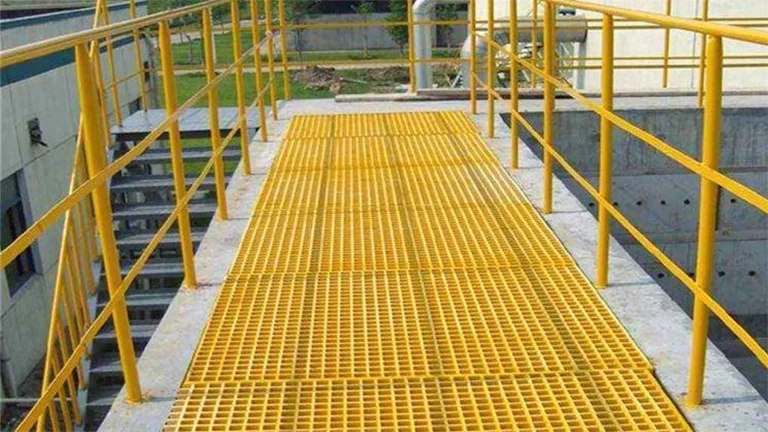
Molded FRP grating is cured as an integral grid in a mould; pultruded grating is assembled from separately formed bearing bars and transverse rods. Compare the actual support layout, load case, deflection criterion and exposure before choosing. The manufacturing name alone does not establish which offered panel is suitable.
How construction changes the comparison
Molding places glass reinforcement and resin in a grid-shaped mould and cures them together. Pultrusion pulls continuous reinforcement through resin and a forming die to produce profiles; bearing bars and transverse rods are then assembled into a panel. These different arrangements explain why panel orientation and cutouts need different checks.
| Compare | Molded grating | Pultruded grating |
|---|---|---|
| Load path and orientation | Common square-mesh constructions have intersecting reinforced ribs. Check the exact product's load table and support arrangement before treating the two directions as equivalent. | Parallel bearing bars define the principal span direction. Match those bars to the supports; cross-rods do not make the panel interchangeable in both directions. |
| Cutouts and notches | Identify the ribs interrupted by an opening and the remaining supported panel. A molded grid does not automatically remove the need for local support. | Identify which bearing bars are cut and how the remaining bars reach the supports. Resolve any framing or support change on the drawing. |
| Surface and resin | Select the actual surface and resin system for the service conditions, separately from the molded construction. | Select the actual surface and resin system for the service conditions, separately from the pultruded construction. |
| Evidence for comparison | Use data for the offered mesh, depth, resin and surface at the stated clear span and load case. | Use data for the offered bar profile, spacing, resin and surface at the same clear span and load case. |
When to compare each option
Consider a molded option when its grid and proposed cut-piece layout suit the actual supports. Consider a pultruded option when its main bearing-bar direction and profile suit that layout. Neither is a completed selection until the offered product meets the project's load and deflection requirements, with suitable exposure, fire or slip evidence where required. Do not assume every pultruded panel is stronger or every molded panel more chemically resistant.
Compare the same installed duty
Keep clear span, support arrangement, load type and contact area, deflection criterion and environment the same. Then compare the identified product series and its data. Panel thickness or weight alone cannot replace that comparison, and ultimate or breaking load is not an allowable service-load value.
For product context, see molded FRP grating, FRP grating RFQ checklist and FRP panel size and support span RFQ details.
Specification details to confirm
| Detail | Why it matters | What buyers should send |
|---|---|---|
| Grating type | Defines quotation basis | Molded, pultruded or drawing-specified wording |
| Application area | Helps RFQ review | Platform, walkway, trench, drain cover, wet area or chemical area |
| Panel size | Defines cutting and packing | Width, length, thickness and quantity |
| Opening or spacing | Defines panel structure | Mesh size, bar spacing, pitch or drawing value |
| Support span | Needed for review | Clear span, support direction and layout drawing |
| Surface | Affects walking surface request | Concave, gritted, covered top or project wording |
| Resin and color | Affects quotation basis | Resin request, color and exposure note |
| Cutouts and edge trim | Affects fabrication | Cutout dimensions, notch locations, edge trim and panel marks |
| Packing and destination | Needed for export review | Pallet, bundle, marks, destination and loading notes |
Key terms to clarify
- Molded FRP grating: FRP grating commonly specified by molded panel, mesh size, thickness and surface.
- Pultruded FRP grating: FRP grating wording that usually needs bar direction, spacing and support span review.
- Support span: The clear distance between supports under the panel.
- Gritted surface: A surface request used to improve walking traction, subject to project confirmation.
What to prepare before sending RFQ
For a faster molded or pultruded FRP grating review, prepare:
- Grating type or drawing wording.
- Application area and exposure notes.
- Panel size, thickness and quantity.
- Mesh size, bar spacing or drawing value.
- Support span and support direction.
- Surface request.
- Resin and color request.
- Cutouts, notches, edge trim and marks.
- Packing, destination and drawings.
RFQ checklist
Before sending a molded vs pultruded FRP grating RFQ, confirm:
- Grating type.
- Application area.
- Panel size and thickness.
- Mesh size or bar spacing.
- Support span and direction.
- Surface request.
- Resin and color.
- Cutouts and edge trim.
- Quantity.
- Packing, destination and drawings.
Related QY pages
- Molded FRP grating for the main FRP grating product page.
- FRP grating RFQ checklist for corrosive or wet flooring RFQ details.
- FRP panel size and support span for span and sizing details.
- FRP anti-slip surface selection for surface request context.
- FRP covered-top vs open-mesh grating for surface and drainage comparison.
- Contact QY Metal Tech when drawings and FRP grating details are ready.
FAQ
What should a molded vs pultruded FRP grating RFQ include?
Send grating type, application area, panel size, thickness, mesh size or bar spacing, support span, surface, resin, color, cutouts, quantity, packing and drawings.
Is "FRP grating" enough for quotation?
No. Buyers should confirm whether the request is molded, pultruded or drawing-specified, then provide panel size, support span, surface, resin, quantity and drawings.
Why does support direction matter for FRP grating?
Support direction helps review how the panel is placed on supports and whether the main span direction matches the drawing or project request.
Can QY confirm load rating from molded or pultruded wording alone?
QY should not claim load rating from product wording alone. Load review needs confirmed panel type, span, thickness, support condition and project data.
Related links
Related products and RFQ guides
- FRP grating productsOpen the related product family section.
- FRP grating topic entryFRP grating family page for molded FRP grating, trench covers, car wash grating, tree grates and wet or corrosive access areas.
- FRP trench coversRelated product or guide page.
- FRP grating selection guideRelated product or guide page.
- FRP Grating vs Galvanized Steel Grating for Wet AreasComparison guide for wet or corrosive area grating selection, covering FRP grating and galvanized steel grating by environment, traffic, support, cutouts and quotation details.
- FRP Grating RFQ Checklist for Corrosive and Wet FlooringFRP grating RFQ checklist covering wet or corrosive environment, panel size, support condition, thickness, mesh size, surface, color or resin request, quantity and destination.


