
FRP Grating
Molded FRP Grating
Molded FRP grating is used for wet, chemical, marine and wastewater access areas where corrosion resistance, light handling, drainage and anti-slip walking surfaces matter. Buyers should confirm thickness, mesh size, resin system, surface type, support span, color and cutout details before quotation.
RFQ quick details
Standard molded FRP grating panels
| Thickness × mesh (c/c) | Approx. weight | Open area | Common panel sizes |
|---|---|---|---|
| 25 × 38 × 38 mm | ≈ 12.6 kg/m² | ≈ 68% | 1220 × 3660 mm, 1220 × 2440 mm |
| 30 × 38 × 38 mm | ≈ 15 kg/m² | ≈ 68% | 1220 × 3660 mm, 1220 × 2440 mm |
| 38 × 38 × 38 mm | ≈ 19.6 kg/m² | ≈ 68% | 1220 × 3660 mm, 1220 × 2440 mm, 1007 × 3007 mm |
| 50 × 50 × 50 mm | ≈ 21.5 kg/m² | ≈ 70% | 1220 × 3660 mm, 1220 × 2440 mm |
Reference weights follow the QY parameter chart for the listed open-grid construction. Actual mass varies with resin, surface and cut details; confirm the offered panel before ordering. Weight calculation guide
Resin, surface and color options
| Option | Typical use |
|---|---|
| Orthophthalic polyester (O) | General industrial floors and mild, mostly dry environments. |
| Isophthalic polyester (I) | Water and wastewater, marine air and moderate chemical exposure. |
| Vinyl ester (VE) | Strong acids, alkalis, chlorine and chemical process areas. |
| Phenolic (P) | Low-smoke, fire-sensitive areas such as offshore platforms and tunnels. |
| Surface | Concave (meniscus), gritted anti-slip, smooth or covered top. |
| Color | Yellow, green, grey, dark grey, black, blue or project color. |
| Outdoor UV | UV inhibitor or surface veil for long-term outdoor exposure. |
General selection guide. The resin is confirmed from the chemical name, concentration and temperature. Fire ratings are stated only with the test report for the ordered resin; span and load are checked for each project.
Product overview
How to Specify Molded FRP Grating for RFQs
QY Metal Tech reviews molded FRP grating inquiries by site exposure, support condition, panel layout, surface requirement, cutout details and packing notes so the quotation can match the real project instead of only a product name.
Molded FRP Grating specification path
| Thickness | Choose thickness by support span, pedestrian or maintenance load and handling requirement. |
|---|---|
| Mesh size | Mesh opening affects drainage, walking comfort, panel weight and bearing capacity. |
| Resin system | Select resin by chemical, UV, marine or wastewater exposure. |
| Surface | Concave, gritted or covered-top surfaces should match anti-slip and cleaning needs. |
| Panel details | Confirm panel size, cutouts, color, clips, support direction and packing marks. |
Standards reference
FRP Standards and Property References
- FRP grating can be reviewed by thickness, mesh size, resin system, color, surface and project drawings.
- ASTM E84 addresses surface flame spread and smoke development under specified exposure conditions; ASTM D635 addresses burning rate or extent and time of burning of horizontal plastic specimens.
- ASTM D2583 addresses Barcol indentation hardness. A hardness result does not establish a fire classification or grating load capacity.
- For load selection, match the exact product series, clear support span, load case and deflection limit using the FRP grating load and support-span guide. Request the applicable report and match its method, edition and product identity to the purchase requirement.
- Outdoor, wet and pedestrian projects should confirm anti-slip surface, UV exposure, support condition and local access requirements.
- Final specification should follow project drawings, operating environment and buyer approval documents.
Specification examples
Common Molded FRP Grating RFQ Models
| 38 x 38 x 38 mm FRP | Common molded FRP grating size for wet access floors. |
|---|---|
| 50 x 50 x 50 mm FRP | Heavier molded FRP panel option reviewed by span and load. |
| Gritted surface panel | Anti-slip surface for pedestrian and wet areas. |
| Resin/color option | Resin type and color confirmed by environment and project requirement. |
Use these expressions as RFQ shorthand, then confirm panel dimensions, support span, resin system, surface, color, cutouts and drawings before production.
Applications
Common Applications for Molded FRP Grating
These references connect molded FRP grating choices with wet access floors, chemical environments, stock panel cutting and project packing requirements.
Wet and washdown access
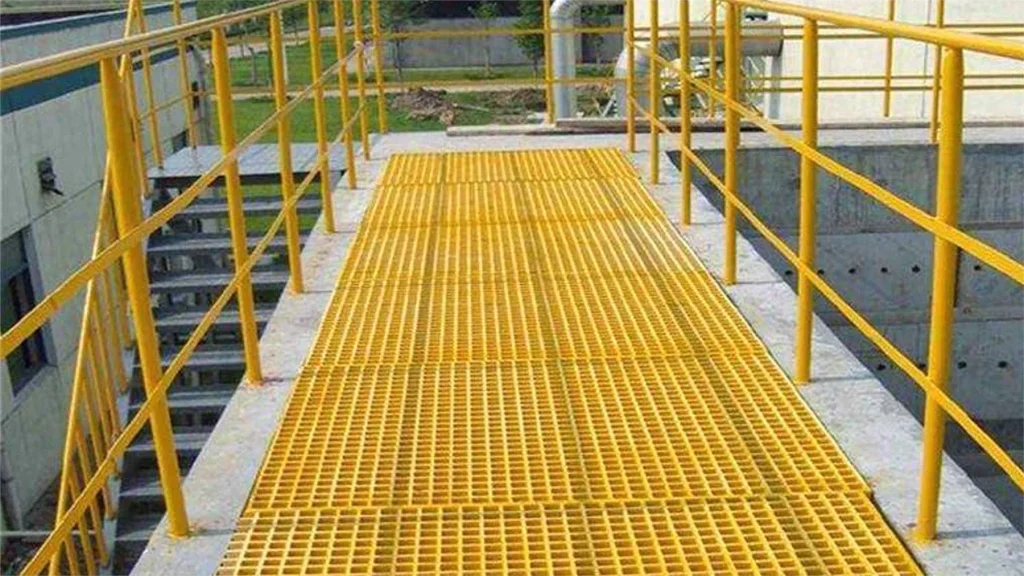
Yellow molded FRP grating is often used for wastewater, washdown and outdoor maintenance walkways.
Chemical and wastewater floors
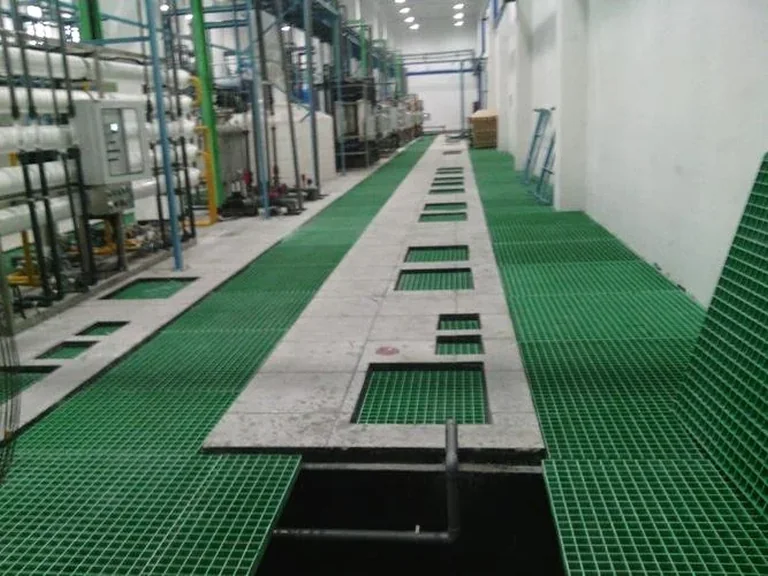
Green molded FRP panels can be selected where corrosion resistance, drainage and light handling are needed.
Stock panels and custom cutting
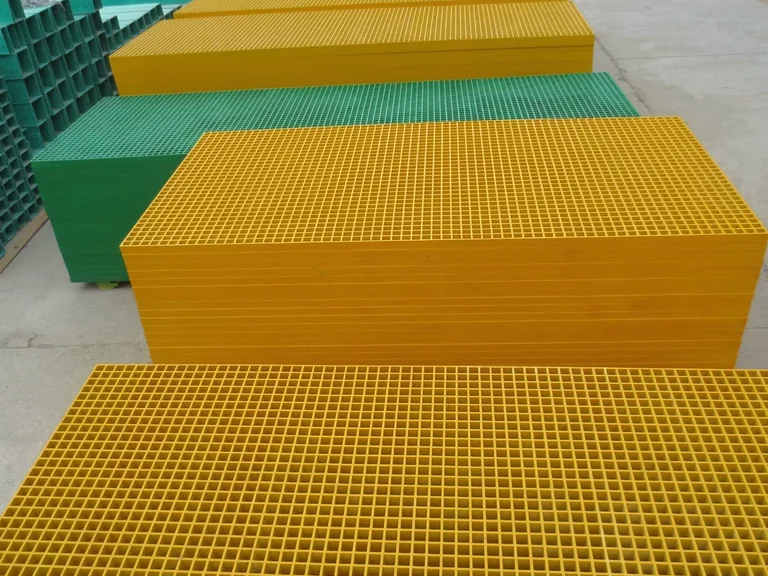
Stacked molded FRP panels can be cut to size with confirmed color, mesh, clips and packing marks.
FRP grating technical references
Use these references with the applicable project assumptions. They support pre-quotation screening and are not a certificate or engineering approval. Final quotation follows the confirmed drawing, dimensions, load or service conditions.
Technical checks before quotation
- Confirm resin system, bearing depth, mesh opening and panel dimensions.
- Match span, load direction and deflection requirements to the selection guide.
- Confirm chemical service, color, surface option and support details; screening guidance is not a certificate.
RFQ checklist
Send Molded FRP Grating RFQ Details
For faster quotation support, include thickness, mesh size, panel size, resin, color, surface, support span, load condition, cutouts, quantity and destination. Drawings, sketches or replacement photos are useful when panels must fit an existing site.
Molded FRP Grating RFQ checklist
- Thickness, mesh size, panel size, support span and load condition
- Resin type, color, surface type, UV or chemical environment
- Cutouts, clips, support direction, quantity and destination
- Drawings, site photos, replacement panel dimensions and packing notes
FAQ
Molded FRP Grating Buyer Questions
What is molded FRP grating used for?
It is used for wet, chemical, marine and wastewater access areas where corrosion resistance, light weight, drainage and an anti-slip walking surface matter.
What sizes are common?
38 × 38 × 38 mm (thickness × mesh) is a common size for wet access floors. 50 × 50 × 50 mm is a heavier option reviewed by span and load.
Which resin should I choose?
It depends on the real exposure. Send the chemical name, concentration, temperature and contact mode (immersion, splash or washdown). Our screening guide gives candidate resins only; critical service needs supplier data or coupon testing.
How far can molded FRP grating span?
It depends on the product series, thickness, load case and deflection limit. Match your clear span and load with the FRP load and span guide before selecting thickness.
Gritted or concave surface: which one?
A gritted or covered-top surface gives more grip on wet walkways. A concave surface can be enough where cleaning and drainage matter most.
Can molded FRP grating be cut to size?
Yes. Stock panels can be cut to your layout; confirm cutouts, edge condition, clips and support direction before production.
Is FRP grating fire rated?
Fire performance depends on the exact product and test. ASTM E84 covers flame spread and smoke; ASTM D635 covers burning rate. Ask for the report that matches your product and requirement.
Related paths
Continue from this product
Need a Molded FRP Grating Quote?
Send drawings, specifications, quantity, destination and packing notes. We will review thickness, resin, surface, panel layout and support condition before replying.
FRP chemical-service screening and release
Source: QY-FRP-CRG-01, Rev. 1.0 / 24 Jul 2026. The guide covers early RFQ screening for molded or pultruded grating, treads and structural profiles. On this page it supports selection of the exact molded-grating product; the PDF remains downloadable.
Not a universal chemical-resistance chart: exposure data → resin shortlist → coupon/supplier review → approved service. Unknown chemistry, concentration, temperature, cleaning or load conditions must be escalated. A generic “vinyl ester” label does not make formulations, laminate build, manufacturing process or service limits equivalent.
Open the detailed chemical-service checklist and reference tables
On small screens, swipe wide tables sideways or focus the table and use the left/right arrow keys.
Exposure data required before resin screening
| Input | Required project information | Why it matters |
|---|---|---|
| Chemical identity | Full name, CAS number, mixture/trade name and SDS | Similar names can represent different exposure risks. |
| Concentration | Normal, minimum and maximum concentration | Dilute and concentrated service can behave differently. |
| Temperature | Continuous, normal peak, upset peak and cleaning temperature | Temperature commonly changes the suitability boundary. |
| Contact mode | Immersion, splash, vapor, intermittent washdown or spill only | Continuous wetting is more severe than occasional contact. |
| Duration | Hours per event, cycles per day and design life | Cumulative exposure and cycling influence risk. |
| Mechanical duty | Span, load, impact, abrasion, cut edges and fasteners | Chemical and mechanical degradation can interact. |
| Hygiene/safety | Food contact, potable water, flame/smoke, slip and electrical requirements | May require independent certification or testing. |
Four approval gates
- A — Complete data: identify the exposure, ranges, units and cleaning/upset conditions.
- B — Traceability: identify resin manufacturer, exact family/formulation, batch and laminate construction.
- C — Matching evidence: review evidence for the actual exposure and mechanical duty.
- D — Project release: record accepted service limits and responsible approval.
The following routes are candidates for an evidence request only, not approved resin recommendations or service ratings.
Preliminary shortlist and escalation triggers
| Exposure family | First screening route | Mandatory escalation triggers |
|---|---|---|
| Water, dilute neutral salts, outdoor moisture | General-purpose or corrosion-grade system may be considered. | Elevated temperature, immersion, potable/food contact, freeze-thaw or electrical duty. |
| Dilute acids | Corrosion-grade or vinyl ester candidate; request exact supplier data. | Oxidizing acids, mixed acids, concentration swings or elevated temperature. |
| Alkalis / caustics | Vinyl ester or specialist system candidate. | High concentration, hot cleaning, alternating acid/alkali or stress exposure. |
| Solvents / fuels / oils | Specialist review only; check swelling, softening and fire requirements. | Aromatics, ketones, chlorinated solvents, immersion or temperature cycling. |
| Oxidizers / disinfectants | Exact formulation review plus coupon or supplier confirmation. | Chlorine compounds, peroxide, ozone, high dose, UV and heat together. |
| Unknown mixtures / process liquor | SDS review, process-owner interview and coupon program. | Any missing constituent, proprietary additive or upset chemistry. |
Decision codes — keep the release limitation with the code
| Code | Meaning | Release condition |
|---|---|---|
| P — Provisional | Potential candidate; evidence incomplete | RFQ only; no service claim |
| C — Conditional | Evidence supports stated limits with conditions | Limits printed on approved submittal |
| T — Test required | Coupon or representative laminate test needed | Acceptance criteria agreed before test |
| N — Not recommended | Evidence indicates unacceptable risk | Offer alternative material/system |
| U — Unknown | Insufficient data | Do not quote as technically approved |
Evidence hierarchy and coupon review
- Prefer a test matching the exact product, laminate and exposure.
- Review supplier data for the exact resin and stated limits.
- Use traceable comparable field history with its differences recorded.
- Use public benchmarks only to plan screening or testing, not as proof that QY’s product was tested.
Coupon-test records
| Record field | Minimum entry |
|---|---|
| Coupon ID | Unique ID linked to product batch and resin certificate |
| Conditioning | Chemical, concentration, temperature, duration, agitation and replenishment |
| Measurements | Mass, dimensions, hardness/appearance and agreed mechanical property |
| Acceptance | Numerical criteria agreed by purchaser/designer before exposure |
| Photos | Before/after with scale, date and coupon ID |
| Disposition | Approved limits, restrictions, retest or rejection |
| Authorization | Prepared, reviewed and customer/designer approval fields |
Chemical testing requires trained personnel, the SDS and a site-approved plan for PPE, ventilation, handling and disposal. The worksheet is not a chemical-handling procedure or permission to conduct an uncontrolled test.
Customer worksheet — blank fields remain project inputs
| Field | Customer / project entry |
|---|---|
| Project / location | [project entry] |
| Chemical / CAS / SDS revision | [project entry] |
| Concentration range | [project entry] |
| Continuous / peak temperature | [project entry] |
| Contact mode and frequency | [project entry] |
| Cleaning chemicals and cycle | [project entry] |
| Span / load / deflection | [project entry] |
| Abrasion / impact / UV | [project entry] |
| Fire / smoke / slip / electrical | [project entry] |
| Required design life | [project entry] |
| Exact QY product / resin / batch | [project entry] |
| Evidence attached | Supplier data / report / coupon / field history / none |
| Decision and limits | P / C / T / N / U: [project entry] |
| Prepared / reviewed / approved | [project entry] |
Release conditions
- Exposure data and units are complete, including peaks, cleaning and upset conditions.
- Exact product, resin and batch are traceable to the evidence.
- Mechanical, fire/smoke, slip and electrical requirements receive their own review; chemical screening does not approve them.
- Evidence, decision code, restrictions and permitted service limits are attached to the submittal.
- The responsible customer/designer approves critical service before technical release.
Selection path
Specification, data and project references
1 · Check technical data
2 · See project references
3 · Datasheet and quotation
Order terms
- MOQ: 50 pcs (panels, rolls or pieces)
- Samples available; sample and freight costs paid by the buyer
- Payment: 30% deposit, 70% before shipment
- Lead time: usually 30 days ex-works after deposit and drawing approval
- Quotation in 24–48 hours on working days
- Drawings: PDF, DWG, DXF, JPG, PNG, WebP up to 12 MB
Product datasheet
Molded FRP Grating datasheet
2-page PDF: typical specifications, what we confirm before quotation, RFQ checklist and contact details. (423 KB)
RFQ form
Request Molded FRP Grating quotation
Upload drawings if available. Include thickness, mesh size, resin, surface, color, support span, quantity, destination and application notes for a faster technical response.
Related links
Related product and RFQ resources
- FRP grating product catalogBrowse the related product family section.
- FRP Grating vs Galvanized Steel Grating for Wet AreasComparison guide for wet or corrosive area grating selection, covering FRP grating and galvanized steel grating by environment, traffic, support, cutouts and quotation details.
- FRP Grating RFQ Checklist for Corrosive and Wet FlooringFRP grating RFQ checklist covering wet or corrosive environment, panel size, support condition, thickness, mesh size, surface, color or resin request, quantity and destination.
- FRP Trench Cover RFQ Guide for Wet and Corrosive AreasFRP trench cover RFQ guide covering trench opening size, support condition, panel size, surface, environment, traffic condition, quantity, packing and destination.
- Send project RFQ detailsSend drawings, dimensions, finish notes, quantity and destination for review.
Factory verification and order terms
Video factory visits by appointment
Video factory visits can be arranged in advance. Contact our sales team to agree a time, platform and accessible production, inspection or packing areas. Other customers’ information and confidential areas are not shown.
Lead time: usually 30 days ex-works
For regular orders, production usually takes 30 days ex-works, counted from receipt of the deposit and approval of the drawings. Larger or special orders, and stock availability, are confirmed in the written quotation. Production and transport times are stated separately in the quotation or contract.
Written quotation and delivery terms
Trade terms are agreed for each order and logistics arrangement. The written quotation specifies the applicable Incoterms® 2020 rule, named delivery place or port of shipment, and whether freight, insurance and taxes are included. For containers handed to a carrier before vessel loading, FCA is considered rather than automatically using FOB.
Quality concerns and corrective action
Please provide the order number, affected quantity, photos or video, and relevant measurements or inspection records when reporting a quality concern. If responsibility is confirmed to lie with us, a remedy such as repair, additional supply, replacement, refund or price adjustment is agreed under the contract. Costs and the action plan are confirmed in writing; no unconditional return or fixed resolution period is promised.


