
FRP Grating Surface Review: Site Conditions and Cleaning
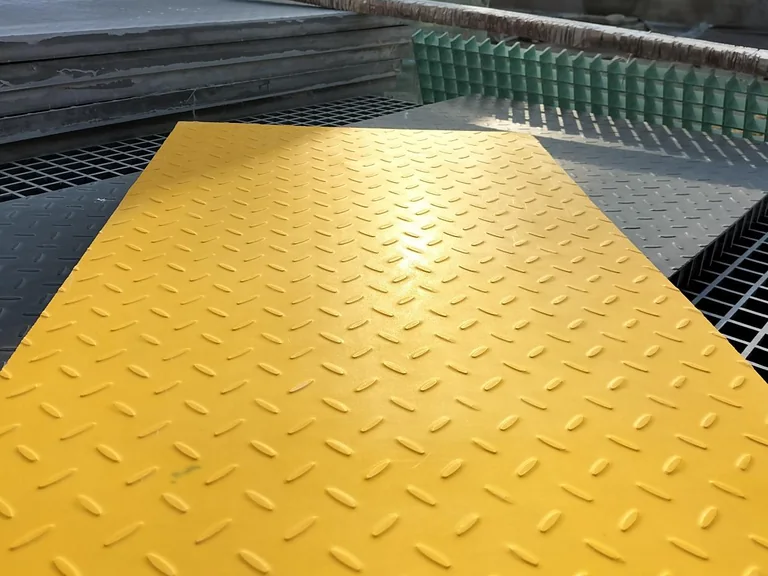
Before choosing an FRP grating surface, describe the conditions that the surface will actually face. “Wet area” can mean occasional rain, a washdown route that remains damp, or a work zone with oil and process residue. These are different review inputs, even when the requested panel dimensions are identical.
This page is a site-condition record for a new floor or a replacement panel. For the comparison of concave, gritted and covered-top options, use the FRP surface selection resource. Here, the aim is to collect the evidence needed to use that comparison, rather than repeat it.
Record conditions by zone and time
Divide the walking route into named zones. Note what is present during normal use, after cleaning and during an unusual spill or weather event. Distinguish an observation from an assumption: “water visible after washdown” is useful; “always safe when wet” is not an inspection result.
| Record | Useful detail | Avoid substituting |
|---|---|---|
| Surface contamination | Water, detergent residue, oil, mud or identified process material | A single label such as “wet” for every condition |
| When it occurs | During a process, after washdown, after rain or at a particular shift | An unsupported claim that the floor is normally dry |
| Users and traffic | Work footwear, other expected users, carts and turning locations | Assuming every zone has the same traffic |
| Cleaning routine | Method, cleaning product, frequency and observed residue | “Regular cleaning” without describing the process |
| Drainage and transitions | Observed standing water, blocked openings and adjacent floor levels | Treating a new surface finish as a drainage repair |
| Project acceptance | The specified test method, conditions and required supporting documents | A generic “anti-slip” label as proof of a rating |
Separate cleaning observations from surface selection
Record how the area is cleaned and what remains afterwards. The UK Health and Safety Executive notes that cleaning can remove contamination but can also introduce wet-floor hazards. Its floor-cleaning guidance is general workplace guidance, not a test result for QY products.
For the quotation record, identify the cleaning method and products already approved for the site. If a cleaning product or procedure is to change, flag that change for compatibility review rather than assuming the existing FRP resin or surface treatment will suit it. This article does not prescribe detergent concentration, pressure-washing settings or a maintenance interval.
For replacement panels, document the existing condition
Photograph the affected area and an adjacent reference area under comparable conditions. Record the location of visible surface wear, loose grit, deposits, damage or obstructed openings without assigning a cause from appearance alone. Add the panel identification or previous order reference when available.
Keep the surface question separate from structural questions. A worn walking surface, a damaged panel and an unsupported edge are not interchangeable findings. Panel damage, fixing concerns or an unsafe route should be referred to the responsible site team; do not use this quotation worksheet as clearance to keep using the area.
Where the need is a broader replacement assessment, consult the FRP repair and replacement inspection guide. For a new panel, retain the FRP product dimensions and support requirements as a separate part of the specification.
Ask what a surface claim actually covers
When a project calls for slip-resistance evidence, include the exact requirement supplied by the project team. Ask which surface, test conditions and specimen the supporting report covers. Do not assume a result obtained on one surface or under one condition applies to every grating configuration or contaminant.
The HSE’s flooring guidance relates surface suitability to workplace activity and contamination. It does not certify a particular QY surface or establish compliance outside its context. Confirm the project’s applicable requirements with the responsible reviewer.
Turn the observations into one clear review request
Use this blank record for each zone. It is an information template, not a real customer case or a claim that a surface has passed a test:
Zone: [reference]. Use and users: [observed conditions]. Contaminant and timing: [record]. Current surface and panel reference: [known details]. Cleaning method and remaining residue: [record]. Drainage or transition concern: [photo reference]. Required test evidence: [project requirement]. Question for review: [surface option / replacement match / missing information].
This gives a supplier a defined question instead of an instruction to provide “the most anti-slip” product. Keep panel dimensions, span, resin requirements and quantity in the accompanying specification; selecting a surface does not settle those fields.
Send the site-condition record and photographs with any project surface requirement. Mark unknown information as awaiting confirmation rather than supplying an estimated rating.
Surface review questions
Is a rougher FRP surface automatically suitable for my site?
No. Record contamination, users, traffic and cleaning conditions, then review the requested surface and any required evidence for that application.
What should I photograph before requesting a replacement surface?
Show the affected zone, a reference area, visible deposits or wear, drainage conditions and the panel identification where available. Photos document observations but do not establish the cause or a slip rating.
Can a new surface finish solve standing water?
Do not treat a surface finish as a drainage repair. Record the water location and surrounding conditions so the site team can review drainage separately from the grating surface.
What evidence should accompany a specified slip-resistance requirement?
Provide the project’s test method and acceptance requirement, and ask which surface, specimen and test conditions the supporting report covers. A surface name alone is not that evidence.
Related resources
Related links
Related products and RFQ guides
- FRP grating productsOpen the related product family section.
- FRP grating topic entryFRP grating family page for molded FRP grating, trench covers, car wash grating, tree grates and wet or corrosive access areas.
- FRP trench coversRelated product or guide page.
- FRP grating selection guideRelated product or guide page.
- FRP Grating vs Galvanized Steel Grating for Wet AreasComparison guide for wet or corrosive area grating selection, covering FRP grating and galvanized steel grating by environment, traffic, support, cutouts and quotation details.
- FRP Grating RFQ Checklist for Corrosive and Wet FlooringFRP grating RFQ checklist covering wet or corrosive environment, panel size, support condition, thickness, mesh size, surface, color or resin request, quantity and destination.


